Shopping at Southern California
3:24 PM
 |
| Shopping |
At Las Americas Premium Outlets , just south of downtown San Diego, enjoy Mexican food at Achiote that’s a step above the usual burrito-and-taco fare. Outlet malls throughout Southern California definitely aim to please the palate as well as the pocketbook. Check restaurant listings for other Premium Outlet Malls in Camarillo , Carlsbad , and Cabazon's Desert Hills mall, as well as for the Citadel Outlets east of Los Angeles, the Lake Elsinore Outlets between Riverside and Temecula, The Block At Orange , and the Cabazon Outlets .
Trip to Catalina Island - California
3:11 PM
 |
| Catalina Island |
Trip time: 3 days
Day 1:
Start with a smooth ride from the mainland across the water on the Catalina Express , arriving in the Mediterranean charm of Avalon. Check out the newly-renovated Pavilion Hotel . Spend some time strolling quaint streets, grab a bite to eat at one of the town's restaurants like the new Avalon Grille , located on the water. Don’t worry about traffic, cars are not allowed on the streets of Avalon. But don’t take too long, your adventure is about to begin.
To get a lay of the land, why not try a Segway tour through Avalon ? Or a new GPS Walking Tour . You could also take sightseeing to new heights with a parasailing trip high above Avalon Harbor. Keep your eyes open (if you can), you’ll get a birds’ eye view of the coast.
How about a bit of history? Take the new Behind the Scenes Casino Tour and go back in time to the glamorous days of big bands and classic movies.
What’s next? How about a Zip Line Eco Tour ? Travel from Descanso Canyon over five consecutive zip lines, at speeds of up to 45mph, experiencing the beauty of the island as you zip down through the canyon, ending up at Descanso Beach.
Day 2:
Today is all about the water.
 |
| Underwater |
Now it’s on to Little Harbor Beach and some fun-in-the-sun. Lunch, kayaks and beach equipment is provided, so gear up and enjoy! If that’s not your thing, take an Adventure Rafting Trip aboard the island’s “Fun Boats.” Snorkel, play with dolphins, and visit Two Harbors. Along the way, watch for bald eagles, flying fish, seals, and sea lions. From January to March, you can also go whale watching.
Can’t get enough of the water? You can rent any number of watercraft , from jetskis and motorboats to kayaks, pedal boats or paddle boards. The choice is yours.
For even more ways to see the island, take an exciting, narrated ride on the Skyline Drive Tour . Along the trip you’ll see spectacular vistas, deep canyons, quiet coves and an endless blue ocean.
Day 3:
Go beneath the waves and come face-to-face with Catalina’s abundant marine life – from bright garibaldi, spotted calico bass, bat rays, and more – as you snorkel in the clear waters and coastal reefs surrounding the island.
If you would rather watch from a distance, step aboard a semi-submersible for an undersea tour . You may even see a shark or two. For an added bonus, take the nighttime tour and see a whole new world that only comes out at night.
California - Outdoor Recreation
3:00 PM
Gold was what brought the world to California more than a century and a half ago. Gold of a different vein — nature’s gold — draws the world to California today. National parks , lakes, rivers, deserts, redwood glens, and wind-tousled peaks; Yosemite , Death Valley , Big Sur and Mt. Lassen — the list of California’s most precious commodities goes on and on. Not to mention the California State Parks system has treasures as diverse as the state: herein you will find the largest and most diverse natural and cultural heritage holdings of any in the nation.
To grasp California’s true gold, you must leave the words behind and go to one of the state’s many special places. Experience the outdoor magic at the edge of Lake Tahoe. Hoist a backpack and head for the backcountry of the Los Padres National Forest near Ojai, where you can hike to a swimming hole framed by a granite gorge. You can even take a boat out to one of the five islands of Southern California's Channel Islands National Park and camp where sea lions outnumber campers a thousand to one. And, families travelling in California will appreciate the state’s commitment to strengthening children’s connection to the great outdoors, with the California Children’s Outdoor Bill of Rights .
READ MORE - California - Outdoor Recreation
To grasp California’s true gold, you must leave the words behind and go to one of the state’s many special places. Experience the outdoor magic at the edge of Lake Tahoe. Hoist a backpack and head for the backcountry of the Los Padres National Forest near Ojai, where you can hike to a swimming hole framed by a granite gorge. You can even take a boat out to one of the five islands of Southern California's Channel Islands National Park and camp where sea lions outnumber campers a thousand to one. And, families travelling in California will appreciate the state’s commitment to strengthening children’s connection to the great outdoors, with the California Children’s Outdoor Bill of Rights .
More Information and Articles About California
1:47 PM
For more information and article about California, Visit Index of California on Wikipedia
READ MORE - More Information and Articles About California
Rivers in California
1:21 PM
 |
| California Rivers and Lakes |
The Owens River takes runoff from the southeastern slopes of the Sierra Nevada and flows into Owens Lake. The Eel River and Salinas River each drain portions of the California coast, north and south of San Francisco Bay, respectively. The Mojave River is the primary watercourse in the Mojave Desert and the Santa Ana River drains much of the Transverse Ranges and bisects Southern California.
List of rivers in California.
Terrestrial Paradise, History Of "The Island of California"
1:08 PM
The first known mention of the legend of the "Island of California" was in the 1510 romance novel Las sergas de Esplandián by Garci Rodríguez de Montalvo—the sequel to Montalvo's more famous tales of Amadis de Gaula, father of Esplandian. He described the island in this passage:
It is probable that this description prompted early explorers to misidentify the peninsula of Baja California as the island in these legends.
In 1533, Fortún Ximénez, a mutineer on an exploring expedition sent by Hernán Cortés, discovered the southern portion of Baja California, around La Paz. Cortés himself followed up on the discovery with an expedition to La Paz, but the settlement had to be abandoned soon afterwards. Cortés' limited information on southern Baja California apparently led to the naming of the region after the legendary California and to an initial but short-lived assumption that it was a large island.
In 1539, Cortés sent the navigator Francisco de Ulloa northward along the Gulf and Pacific coasts of Baja California. Ulloa reached the mouth of the Colorado River at the head of the Gulf, which seemed to prove that the region was a peninsula rather than an island. An expedition under Hernando de Alarcón ascended the lower Colorado River and confirmed Ulloa's finding. Maps published subsequently in Europe during the 16th century, including those by Gerardus Mercator and Abraham Ortelius, correctly showed California as a peninsula.
Despite this evidence, however, the depiction of California as an island revived in the early 17th century. One contributing factor may have been the second voyage of Juan de Fuca in 1592. Fuca claimed to have explored the western coast of North America and to have found a large opening that possibly connected to the Atlantic Ocean —- the legendary Northwest Passage. Fuca's claim remains controversial because there is only one surviving written account of it found, his account as related to an Englishman, Michael Locke. Nonetheless, this account claims Fuca found a large strait, with a large island at its mouth, at around 47° north latitude. The Strait of Juan de Fuca is in fact at around 48° N, as is the southern tip of the large island now called Vancouver Island, while the northern reach of the Gulf of California terminates much farther south, at about 31° N. It is possible that explorers and mapmakers in the 17th century could have confused the two (if in fact they were aware of Fuca's voyage), and in any case further exploration was inevitable. Indeed the famed British explorer James Cook barely missed the Strait of Juan de Fuca in March 1778, almost 200 years later. Cook even named Cape Flattery (at the northwest tip of modern Washington state) which is at the mouth of the strait, and instead stopped in Nootka Sound just off the west coast of Vancouver Island at about 49° N. His account states "we saw nothing like [the Strait of Juan de Fuca]; nor is there the least probability that ever any such thing existed."[1] However, Cook describes some bad weather in his account around this time, and did continue on to map most of the outer Pacific coastline of North America from modern day northern California to the Bering Strait in Alaska on the same voyage.
Reports from Oñate's expedition reached Antonio de la Ascención, a Carmelite friar who had participated in Sebastián Vizcaíno's explorations of the west coast of California in 1602 and 1603. Ascención was a tireless propagandist in favor of Spanish settlement in California, and his later writings referred to the region as an island. As older maps confirm, Spanish authorities and local residents were well aware where the actual northern terminus of the Gulf of California lay, but by extending the coastline north past Cape Mendocino and eventually even into Puget Sound, Drake's claim of Nova Albion for England (1579) could be invalidated by the priority of Cortes' claim (1533).
Shortly thereafter an overland expedition was led by the founding governor of New Mexico, Juan de Oñate. The expedition descended the Colorado River in 1604 and 1605, and the official report claimed that from a vantage point the participants could see better where the Gulf of California continued off to the northwest (presumably behind in the Sierra Cucapá into the Laguna Macuata Basin). Subsequently, the first known reappearance of the Island of California on a map dates to 1622 in a map by Michiel Colijn of Amsterdam. The image became the standard for many later maps throughout the 17th century and intermittently into the 18th century. Previous maps show the Gulf terminating in its correct location. The stretch of the Gulf between its actual terminus and Juan de Fuca's strait was written Mare Vermexo ("Sea of See Better") on later maps drawn from Spanish sources. (At the time, Dutch map-makers lived under Spanish control.)
The Jesuit missionary and cartographer Eusebio Francisco Kino revived the fact that Baja California was a peninsula. While studying in Europe, Kino had accepted the insularity of California, but when he reached Mexico he began to have doubts. He made a series of overland expeditions from northern Sonora to areas within or near the Colorado River's delta in 1698–1706, in part to provide a practical route between the Jesuits' missions in Sonoran and Baja California but also to resolve the geographical question. Kino satisfied himself that a land connection must exist, and the 18th century Jesuits generally followed his example. However, Juan Mateo Manje, a military companion on several of Kino's treks, expressed scepticism; European cartographers remained divided on the question.
Jesuit missionary-explorers in Baja California who attempted to lay the issue finally to rest included Juan de Ugarte (1721), Ferdinand Konščak (1746), and Wenceslaus Linck (1766). The matter was settled beyond all dispute when the expeditions of Juan Bautista de Anza traveled between Sonora and the west coast of California in the period 1774–1776.
References
Original article from Wikipedia.
READ MORE - Terrestrial Paradise, History Of "The Island of California"
Know, that on the right hand of the Indies there is an island called California very close to the side of the Terrestrial Paradise; and it is peopled by black women, without any man among them, for they live in the manner of Amazons.
 |
| Map of California, circa 1650; restored. (from Wikipedia) |
It is probable that this description prompted early explorers to misidentify the peninsula of Baja California as the island in these legends.
In 1533, Fortún Ximénez, a mutineer on an exploring expedition sent by Hernán Cortés, discovered the southern portion of Baja California, around La Paz. Cortés himself followed up on the discovery with an expedition to La Paz, but the settlement had to be abandoned soon afterwards. Cortés' limited information on southern Baja California apparently led to the naming of the region after the legendary California and to an initial but short-lived assumption that it was a large island.
In 1539, Cortés sent the navigator Francisco de Ulloa northward along the Gulf and Pacific coasts of Baja California. Ulloa reached the mouth of the Colorado River at the head of the Gulf, which seemed to prove that the region was a peninsula rather than an island. An expedition under Hernando de Alarcón ascended the lower Colorado River and confirmed Ulloa's finding. Maps published subsequently in Europe during the 16th century, including those by Gerardus Mercator and Abraham Ortelius, correctly showed California as a peninsula.
Despite this evidence, however, the depiction of California as an island revived in the early 17th century. One contributing factor may have been the second voyage of Juan de Fuca in 1592. Fuca claimed to have explored the western coast of North America and to have found a large opening that possibly connected to the Atlantic Ocean —- the legendary Northwest Passage. Fuca's claim remains controversial because there is only one surviving written account of it found, his account as related to an Englishman, Michael Locke. Nonetheless, this account claims Fuca found a large strait, with a large island at its mouth, at around 47° north latitude. The Strait of Juan de Fuca is in fact at around 48° N, as is the southern tip of the large island now called Vancouver Island, while the northern reach of the Gulf of California terminates much farther south, at about 31° N. It is possible that explorers and mapmakers in the 17th century could have confused the two (if in fact they were aware of Fuca's voyage), and in any case further exploration was inevitable. Indeed the famed British explorer James Cook barely missed the Strait of Juan de Fuca in March 1778, almost 200 years later. Cook even named Cape Flattery (at the northwest tip of modern Washington state) which is at the mouth of the strait, and instead stopped in Nootka Sound just off the west coast of Vancouver Island at about 49° N. His account states "we saw nothing like [the Strait of Juan de Fuca]; nor is there the least probability that ever any such thing existed."[1] However, Cook describes some bad weather in his account around this time, and did continue on to map most of the outer Pacific coastline of North America from modern day northern California to the Bering Strait in Alaska on the same voyage.
Reports from Oñate's expedition reached Antonio de la Ascención, a Carmelite friar who had participated in Sebastián Vizcaíno's explorations of the west coast of California in 1602 and 1603. Ascención was a tireless propagandist in favor of Spanish settlement in California, and his later writings referred to the region as an island. As older maps confirm, Spanish authorities and local residents were well aware where the actual northern terminus of the Gulf of California lay, but by extending the coastline north past Cape Mendocino and eventually even into Puget Sound, Drake's claim of Nova Albion for England (1579) could be invalidated by the priority of Cortes' claim (1533).
Shortly thereafter an overland expedition was led by the founding governor of New Mexico, Juan de Oñate. The expedition descended the Colorado River in 1604 and 1605, and the official report claimed that from a vantage point the participants could see better where the Gulf of California continued off to the northwest (presumably behind in the Sierra Cucapá into the Laguna Macuata Basin). Subsequently, the first known reappearance of the Island of California on a map dates to 1622 in a map by Michiel Colijn of Amsterdam. The image became the standard for many later maps throughout the 17th century and intermittently into the 18th century. Previous maps show the Gulf terminating in its correct location. The stretch of the Gulf between its actual terminus and Juan de Fuca's strait was written Mare Vermexo ("Sea of See Better") on later maps drawn from Spanish sources. (At the time, Dutch map-makers lived under Spanish control.)
The Jesuit missionary and cartographer Eusebio Francisco Kino revived the fact that Baja California was a peninsula. While studying in Europe, Kino had accepted the insularity of California, but when he reached Mexico he began to have doubts. He made a series of overland expeditions from northern Sonora to areas within or near the Colorado River's delta in 1698–1706, in part to provide a practical route between the Jesuits' missions in Sonoran and Baja California but also to resolve the geographical question. Kino satisfied himself that a land connection must exist, and the 18th century Jesuits generally followed his example. However, Juan Mateo Manje, a military companion on several of Kino's treks, expressed scepticism; European cartographers remained divided on the question.
Jesuit missionary-explorers in Baja California who attempted to lay the issue finally to rest included Juan de Ugarte (1721), Ferdinand Konščak (1746), and Wenceslaus Linck (1766). The matter was settled beyond all dispute when the expeditions of Juan Bautista de Anza traveled between Sonora and the west coast of California in the period 1774–1776.
References
- Laylander, Don, 2004. "Geographies of Fact and Fantasy: Oñate on the Lower Colorado River, 1604–1605". Southern California Quarterly 86:309–324.
- León-Portilla, Miguel. 1989. Cartografía y crónicas de la antigua California. Universidad Nacional Autónoma de México, Mexico City.
- McLaughlin, Glen, with Nancy H. Mayo. The Mapping of California as an Island: An Illustrated Checklist. Saratoga, CA: California Map Society, 1995 .
- Polk, Dora Beale. 1991. The Island of California: A History of the Myth. Arthur H. Clark, Spokane, Washington.
- Tooley, R. V. 1964. California as an Island: A Geographical Misconception Illustrated by 100 Examples from 1625–1770. Map Collectors' Circle, London.
Original article from Wikipedia.
Origin of the name California
12:57 PM
The word California originally referred to the entire region composed of what is today the state of California, plus all or parts of Nevada, Utah, Arizona, and Wyoming, and the Mexican peninsula of Baja California.
The name California is most commonly believed to have derived from a fictional paradise peopled by Black Amazons and ruled by Queen Calafia. The story of Calafia is recorded in a 1510 work The Exploits of Esplandian, written as a sequel to Amadís de Gaula by Spanish adventure writer Garci Rodríguez de Montalvo. The kingdom of Queen Calafia, according to Montalvo, was said to be a remote land inhabited by griffins and other strange beasts, and rich in gold.
Know ye that at the right hand of the Indies there is an island called California, very close to that part of the Terrestrial Paradise, which was inhabited by black women without a single man among them, and they lived in the manner of Amazons. They were robust of body with strong passionate hearts and great virtue. The island itself is one of the wildest in the world on account of the bold and craggy rocks.
The name California is the fifth-oldest surviving European place-name in the U.S. and was applied to what is now the southern tip of Baja California as the island of California by a Spanish expedition led by Diego de Becerra and Fortun Ximenez, who landed there in 1533 at the behest of Hernando Cortes.
Read more - Origin of the name California
READ MORE - Origin of the name California
The name California is most commonly believed to have derived from a fictional paradise peopled by Black Amazons and ruled by Queen Calafia. The story of Calafia is recorded in a 1510 work The Exploits of Esplandian, written as a sequel to Amadís de Gaula by Spanish adventure writer Garci Rodríguez de Montalvo. The kingdom of Queen Calafia, according to Montalvo, was said to be a remote land inhabited by griffins and other strange beasts, and rich in gold.
Know ye that at the right hand of the Indies there is an island called California, very close to that part of the Terrestrial Paradise, which was inhabited by black women without a single man among them, and they lived in the manner of Amazons. They were robust of body with strong passionate hearts and great virtue. The island itself is one of the wildest in the world on account of the bold and craggy rocks.
The name California is the fifth-oldest surviving European place-name in the U.S. and was applied to what is now the southern tip of Baja California as the island of California by a Spanish expedition led by Diego de Becerra and Fortun Ximenez, who landed there in 1533 at the behest of Hernando Cortes.
Read more - Origin of the name California
The Island of California - Terrestrial Paradise
12:57 PM
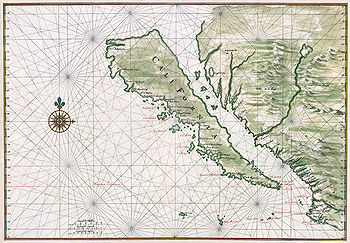 |
| Map of California, circa 1650; restored. (From Wikipedia) |
One of the most famous cartographic errors in history, it was propagated on many maps during the 17th and 18th centuries, despite contradictory evidence from various explorers. The legend was initially infused with the idea that California was a terrestrial paradise, like the Garden of Eden or Atlantis.
State of California
12:48 PM

The name California once referred to a large area of North America claimed by Spain that included much of modern-day Southwestern United States and the Baja California peninsula. Beginning in the late 18th century, the area known as Alta California, comprising the California territory north of the Baja Peninsula, was colonized by the Spanish Empire as part of the Viceroyalty of New Spain. In 1821, Alta California became a part of Mexico following its successful war for independence. Shortly after the beginning of the Mexican-American War in 1846, a group of American settlers in Sonoma declared an independent California Republic in Alta California. Though its existence was short-lived, its flag became the precursor for California's current state flag. American victory in the war led to the Treaty of Guadalupe Hidalgo, in which Mexico ceded Alta California to the United States. Western areas of Alta California became the state of California, which was admitted as the 31st state on September 9, 1850.
The California Gold Rush beginning in 1848 led to dramatic social and demographic change, with large scale immigration from the U.S. and abroad and an accompanying economic boom. Key developments in the early 20th century included the emergence of Los Angeles as the center of the American entertainment industry, and the growth of a large, state-wide tourism sector. The late 20th century saw the development of the technology and information sectors, punctuated by the growth of Silicon Valley. In addition to California's prosperous agricultural industry, other important contributors to its economy include aerospace, education, and manufacturing. If California were a country, it would be the eighth-largest economy in the world and the 35th most populous nation.
Source : Wikipedia
Queen Calafia - A Fictional Warrior
12:12 PM
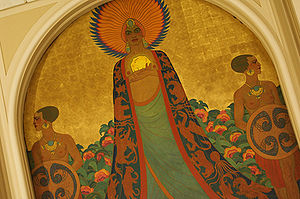 |
| Mural of Queen Calafia and her Amazons in the Room of the Dons at the Mark Hopkins Hotel, San Francisco, California |
In the novel, Calafia is a pagan who is convinced to raise an army of women warriors and sail away from California with a large flock of trained griffins so that she can join a Moslem battle against Christians who are defending Constantinople. In the siege, the griffins harm enemy and friendly forces, so they are withdrawn. Calafia and her ally Radiaro fight in single combat against the Christian leaders, a king and his son the knight Esplandián. Calafia is bested and taken prisoner, and she converts to Christianity. She marries a cousin of Esplandián and returns with her army to California for further adventures.
The name of Calafia was likely formed from the Arabic word khalifa (religious state leader) which is known as caliph in English and califa in Spanish. Similarly, the name of Calafia's monarchy, California, likely originated from the same root, fabricated by the author to remind the 16th century Spanish reader of the reconquista, a centuries-long fight between Christians and Moslems which had recently concluded in Spain. The character of Calafia is used by de Montalvo to portray the superiority of chivalry in which the attractive virgin queen is conquered, converted to Christian beliefs and married off. The book was very popular for many decades—Hernán Cortés read it—and it was selected by author Miguel de Cervantes as the first of many harmful books to be burnt by characters in his famous novel Don Quixote.
Calafia, also called Califia, has been depicted as the Spirit of California, and has been the subject of modern-day sculpture, paintings, stories and films; she often figures in the myth of California's origin, symbolizing an untamed and bountiful land prior to European settlement.
Source : Wikipedia
A Trip to Giblaltar - Information
1:57 AM
A day spent in Gibraltar is not one to be missed. Gibraltar is an overseas territory of the UK and still the site of a large naval base. It lies between Spain and Africa and is easily accessed through Spain by car or on foot (you will need to bring your passport for entry). To get to Africa there is a short ferry that takes you straight into Morroco where a wealth of shopping and culture awaits you.
The pillar of the island is of course the Rock of Gibraltar. There is a cable car that takes you straight to the top and from here you can enjoy the spectacular view, explore caves, tunnels, a Medieval Castle and meet the notorious Barbary Apes, who were around before the British capture of the rock and superstition holds that if the Apes leave then so will the British.
The monkeys are not the only wildlife on the island. Off shore, schools of dolphins like to swim in the bay and there are various boat tours organised for dolphin spotting. Wales have also been known to migrate here and you may even be lucky enough to witness the greatest mammal of all, The Blue Whale. The Upper Rock in spring and autumn is also the stage for millions of migrating birds, so if you’re a bird spotter keep your eyes open, for eagles, vultures, buzzards, the Peregrine Falcon, the Blue Rock Thrush and the rare Barbary Partridge.
READ MORE - A Trip to Giblaltar - Information
The pillar of the island is of course the Rock of Gibraltar. There is a cable car that takes you straight to the top and from here you can enjoy the spectacular view, explore caves, tunnels, a Medieval Castle and meet the notorious Barbary Apes, who were around before the British capture of the rock and superstition holds that if the Apes leave then so will the British.
The monkeys are not the only wildlife on the island. Off shore, schools of dolphins like to swim in the bay and there are various boat tours organised for dolphin spotting. Wales have also been known to migrate here and you may even be lucky enough to witness the greatest mammal of all, The Blue Whale. The Upper Rock in spring and autumn is also the stage for millions of migrating birds, so if you’re a bird spotter keep your eyes open, for eagles, vultures, buzzards, the Peregrine Falcon, the Blue Rock Thrush and the rare Barbary Partridge.
Traveling to London
6:52 PM
 |
| Visiting London |
I took two weeks off from work and went over. I know two weeks isn’t a long time but I’m American and we don’t get a lot of vacation time. Anyways, I went over there and I was a bit dissapointed by London. I had always heard so much about the city that I was expecting this amazing plus, but like always, the image in your head never lives up to the reality of the place you are visiting. But London was a big dissapointment. It was expensive, it was boring, it was cold- and I mean the people not the weather. Everything was ultra expensive if you wanted to go out. It was 20 pounds for the London Eye!! Rediculous. It seemed like a great place to go to if you were right but for us normal people, anything more than like 2 days there is just too pricey.
Don’t get me wrong- I did shell out the money for stuff. I went to the Tower of London, paid to see westminster abbey and the parliament and of course lots of beers! I did really enjoy how all the museums were free. London is awash in musuems and they made for an awesome way to spend the day. I bounced in and out of like 4 musuems while I was there. It rocked.
Luckily, my friends took some time off too and I managed to get out of the big smoke. We headed to Cornwall since it was June and the weather was pretty good. Cornwall was what I thought when I thought of England. I mean there was lush landscape, lots of farms, small towns, quant little homes, and green space. It seemed like England. And compared to London everyone was much friendlier and things were much cheaper.
Overall, I really enjoyed the England. I loved cornwall. London was nice to visit but I’m not sure I would want to live there. It seems like a fun place to go but the people weren’t so friendly. Cornwall, however, was a place I loved and would move to in a second!!
And if I can ever figure out how to get photos on this site, I’ll add some from my trips!!
Dont Forget Amsterdam
3:31 PM

The first thing to be noted about Amsterdam is how easy and cheap it is to get there. With so many good quality cheap flights available I almost considered not claiming on my companies account! There’s an international airport which is linked to central station by a train service which is modern, clean and very affordable.
After arriving at the station it is only a 2 minute walk to the Damrak (the central square) from which the whole city is a matter of minutes away. The first thing to notice are the bicycles. They are everywhere and with many of the towns streets closed to cars its probably not a bad idea to dust off the peddle pushers yourself.
I opted to take the tram to my hotel which allowed me to enjoy the city without worrying about obstructing cyclists. Amsterdam is beautiful. The canals thread water through the streets bringing a liquid serenity which I have never felt in a city. After alighting at my hotel I was instantly impressed. With over 40 per cent of hotels in Amsterdam being 4-5 star, the fierce competition meant I was being treated like a king for the price of a pauper.
After chatting (in English) with locals in a bar across the road I caught a cab to the Leidseplein. I was told that I could find English speaking plays every night of the week but I found it was me struggling for words. The bright lights and stunning architecture left me dumbstruck. I had bought a Dutch phrase book but with everyone there fluent or practicing English I had actually left it in my case! I found some cheap theatre tickets and decided to return the following night with colleagues.
As my girlfriend will testify, I tend to be highly strung during important work meetings but this time it was my calmness which worried her. It’s just so beautiful here, I told her honestly, it’s like there’s something in the air!î Something tells me my return home won’t be as smooth.
Source : _http://www.mytravelingstory.com/
A Small Piece of Britain off the Atlantic Coast
3:01 PM
If you head true East from Cape Hatteras, North Carolina, with a good running start and a 600mile leap you can land on the coast of Bermuda, a little piece of Great Britain off the coast of the United States. My wife and I, however, opted instead for an airplane flight from Raleigh-Durham Airport, which deposited us at the L.F. Wade International Airport about ten miles outside the capital city of Hamilton.
We arrived in the middle of June, on a bright day with a temperature in the mid-seventies, which I was told was average for the time of year. According to the locals, the temperature never gets colder than 7⁰C, which is around 45⁰F in our system. We considered renting a car, but thought better of it when we realized that, being British, they drive on the left side of the road giving us visions of a nasty head on collision that would undoubtedly be our fault. A taxi brought us in to our hotel in Hamilton.
Hamilton is a beautiful, neat, well maintained city situated on the shore of Hamilton Bay, which itself presents a breathtaking panorama. One of the greatest enjoyments for a visitor to Bermuda is viewing the scenery in and around Hamilton Bay. First time visitors are often captured by the pastel colors and white roofs of the buildings in Bermuda, a characteristic of other islands that are currently or formerly under British rule. The Bahamas are another example.
Our main interest, upon arrival, was to plan to spend days at several of the islands famous beaches. As it turns out, we found our favorite to be the Horseshoe Bay beach. It has the typical pinkish sand that is characteristic of Bermuda’s beaches. It’s never crowded and is as peaceful and relaxing as one could hope for. My wife loves to swim, and I’m more of a suntan lotion, lay on a blanket type. The Horseshoe Bay beach was great for both of use.
It even sports a café where good coffee and lunches are available. We found that there was a shuttle service to get bathers to and from the nearest bus stop for a ride to Hamilton, but we had decided to rent motor scooters which are one of the most common and safe means of transport for visitors, especially those from countries where driving on the right is the custom.
The island is quite small, only about 50 square miles, and most places are accessible using the rented motor scooters. We both like to drive the two-wheelers, so rather than double up; we each rented a scooter and rode as a team to every possible destination on the island over the several days that we were there. For meals, we had lunches packed at our hotel, and ate our special dinners in the hotel dining room. It was a most relaxing vacation. Completely stress free.
READ MORE - A Small Piece of Britain off the Atlantic Coast
We arrived in the middle of June, on a bright day with a temperature in the mid-seventies, which I was told was average for the time of year. According to the locals, the temperature never gets colder than 7⁰C, which is around 45⁰F in our system. We considered renting a car, but thought better of it when we realized that, being British, they drive on the left side of the road giving us visions of a nasty head on collision that would undoubtedly be our fault. A taxi brought us in to our hotel in Hamilton.
Hamilton is a beautiful, neat, well maintained city situated on the shore of Hamilton Bay, which itself presents a breathtaking panorama. One of the greatest enjoyments for a visitor to Bermuda is viewing the scenery in and around Hamilton Bay. First time visitors are often captured by the pastel colors and white roofs of the buildings in Bermuda, a characteristic of other islands that are currently or formerly under British rule. The Bahamas are another example.
Our main interest, upon arrival, was to plan to spend days at several of the islands famous beaches. As it turns out, we found our favorite to be the Horseshoe Bay beach. It has the typical pinkish sand that is characteristic of Bermuda’s beaches. It’s never crowded and is as peaceful and relaxing as one could hope for. My wife loves to swim, and I’m more of a suntan lotion, lay on a blanket type. The Horseshoe Bay beach was great for both of use.
It even sports a café where good coffee and lunches are available. We found that there was a shuttle service to get bathers to and from the nearest bus stop for a ride to Hamilton, but we had decided to rent motor scooters which are one of the most common and safe means of transport for visitors, especially those from countries where driving on the right is the custom.
The island is quite small, only about 50 square miles, and most places are accessible using the rented motor scooters. We both like to drive the two-wheelers, so rather than double up; we each rented a scooter and rode as a team to every possible destination on the island over the several days that we were there. For meals, we had lunches packed at our hotel, and ate our special dinners in the hotel dining room. It was a most relaxing vacation. Completely stress free.
Spinx
9:39 AM
 |
| Spinx in egypt |
The Great Sphinx of Giza is popularly known and features the body of a lion and the head of an Egyptian Pharaoh and, at 65 feet high by 20 feet wide and 241 feet long, it is by far the most impressive standing monolith structure in the world. Older than the great pyramids, it’s believed the Great Sphinx was built in the third millennia BC by the ancient Egyptians. However, several other potential theories of origin abound.
Long a source of controversy and intrigue, there are many theories out there as to the true origins of the Sphinx. While some scholars and scientists date it to the time of the builders of the pyramids at Giza or at least their immediate predecessors, some archeologists hypothesize that this structure was in fact built hundreds if not thousands of years earlier. According to some studies based on the erosion caused by rainwater and other hostile elements, it would not be physically possible for the Great Sphinx to have built at the same time as pyramids. These studies, however, have been widely criticized, although there is evidence to support both positions.
Regardless of whether you follow one theory or the other, the Great Sphinx is an absolutely breathtaking example of humanity’s long standing creativity and ability to sculpt their surroundings. As one of the more awe inspiring instances of human ingenuity the Great Sphinx and Pyramids at Giza are more than just great wonders of Egypt – they are truly wonders of the world and no trip to this ancient land of Pharaohs, curses, and buried treasure would be complete without a tour of these amazing sites. Take it from someone who has both seen the pyramids as well as many of the other great wonders of the world, the ancient structures of Egypt’s Giza area might just be the most amazing place of them all.
Source: _http://www.mytravelingstory.com/
What to Do in Dubai ?!
9:38 AM
While making your travel plans if you happen to find yourself torn between the desert and the sea (almost as tough as being caught between “the moon and New York City”), Dubai is the travel destination for you. Dubai is located in the Arabian Desert on the coast of the Persian Gulf. It is a place where you can go deep-sea fishing one day, “dune bashing” the next and wrap it all up with clubbing at night.
Dubai is the most populous of the seven emirates of the United Arab Emirates (UAE). An emirate is a political territory that is ruled by a Muslim Monarch or emir Emirate is just one of the new words you will have to learn for your trip- souk is another. Souk or Souq refers to the traditional markets or market stalls which still co-exist amongst Dubai’s ultra modern developments.
Sites of the City:
At the Spice Souk you can buy spices from all over the Middle East including cinnamon, cloves and cardamom. Another must see is the Gold Souk, the place for gold jewelry. Dubai isn’t nicknamed the City of Gold for nothing. You also should spend an afternoon in the Bastakiya District to experience historic Dubai. The District is filled with narrow lanes, traditional Arabian architecture and tall wind towers. Wind towers were the only means of cooling homes prior to modern electricity. In addition the Al Fahidi Ford is the largest concentration of courtyard homes. The district has been redone for tourists and many of the homes house museums and art galleries.
If you can’t find all you need at the souks Dubai offers a huge variety of shopping options including the Lamcy Plaza, Al Ghurair City, Mercato Mall, Oasis Centre and Wafi Centre. Dubai has become famous for shopping and millions of people attend the annual Dubai Shopping Festival every February.
Desert Safaris:
There are several tour companies that lead daily desert safaris. Generally there are four tour options: morning, evening, dinner and overnight. The overnight tour is the most adventurous option and includes dune bashing, quad biking, camel riding, sand skiing and sand boarding. Dune bashing is just what it sounds like- driving around at high speeds and jumping, sliding or bashing into the sand dunes. After a long day in the heat the evening, dinner and overnight tour options include a relaxing meal and belly dancing beneath the desert sky.
Deep-sea Fishing:
The waters around Dubai are known for their sailfish, kingfish, barracuda and hammour fish. Chartered boats go out daily and include tackle. The fishing grounds are located about 25-45 miles from the coast of Dubai City. The waters are generally calm with very little wind.
Camel and Horse Racing:No, sadly, camels and horses do not race each other but you can see both sports in Dubai. Dubai is internationally known for horse racing. The Dubai Cup is an annual thoroughbred horse race held at the Nad Al Sheba Racecourse, ten minutes outside the city center. Camel racing is also popular throughout the UAE. Traditionally camel racing was only performed for special occasions like weddings or festivals. However, there are now formalized tracks and races are held from October-April each year.
Dubai is a great place to visit. There are many things to do here and the hotels are amazing. I couldn’t believe the luxury here- one hotel was even its own island. How crazy is that? Make sure you book early though because you can find some good deals now if you book head. I used Hotels Combined when I booked my room. I got a pretty good deal too. Between the posh hotel and the posh environment, Dubai is a luxurious and exciting place to visit.
Source: _http://www.mytravelingstory.com/
READ MORE - What to Do in Dubai ?!
Dubai is the most populous of the seven emirates of the United Arab Emirates (UAE). An emirate is a political territory that is ruled by a Muslim Monarch or emir Emirate is just one of the new words you will have to learn for your trip- souk is another. Souk or Souq refers to the traditional markets or market stalls which still co-exist amongst Dubai’s ultra modern developments.
Sites of the City:
At the Spice Souk you can buy spices from all over the Middle East including cinnamon, cloves and cardamom. Another must see is the Gold Souk, the place for gold jewelry. Dubai isn’t nicknamed the City of Gold for nothing. You also should spend an afternoon in the Bastakiya District to experience historic Dubai. The District is filled with narrow lanes, traditional Arabian architecture and tall wind towers. Wind towers were the only means of cooling homes prior to modern electricity. In addition the Al Fahidi Ford is the largest concentration of courtyard homes. The district has been redone for tourists and many of the homes house museums and art galleries.
If you can’t find all you need at the souks Dubai offers a huge variety of shopping options including the Lamcy Plaza, Al Ghurair City, Mercato Mall, Oasis Centre and Wafi Centre. Dubai has become famous for shopping and millions of people attend the annual Dubai Shopping Festival every February.
Desert Safaris:
There are several tour companies that lead daily desert safaris. Generally there are four tour options: morning, evening, dinner and overnight. The overnight tour is the most adventurous option and includes dune bashing, quad biking, camel riding, sand skiing and sand boarding. Dune bashing is just what it sounds like- driving around at high speeds and jumping, sliding or bashing into the sand dunes. After a long day in the heat the evening, dinner and overnight tour options include a relaxing meal and belly dancing beneath the desert sky.
Deep-sea Fishing:
The waters around Dubai are known for their sailfish, kingfish, barracuda and hammour fish. Chartered boats go out daily and include tackle. The fishing grounds are located about 25-45 miles from the coast of Dubai City. The waters are generally calm with very little wind.
Camel and Horse Racing:No, sadly, camels and horses do not race each other but you can see both sports in Dubai. Dubai is internationally known for horse racing. The Dubai Cup is an annual thoroughbred horse race held at the Nad Al Sheba Racecourse, ten minutes outside the city center. Camel racing is also popular throughout the UAE. Traditionally camel racing was only performed for special occasions like weddings or festivals. However, there are now formalized tracks and races are held from October-April each year.
Dubai is a great place to visit. There are many things to do here and the hotels are amazing. I couldn’t believe the luxury here- one hotel was even its own island. How crazy is that? Make sure you book early though because you can find some good deals now if you book head. I used Hotels Combined when I booked my room. I got a pretty good deal too. Between the posh hotel and the posh environment, Dubai is a luxurious and exciting place to visit.
Source: _http://www.mytravelingstory.com/
10 Places to See in Egypt
9:05 AM
Many cultural wonders but also beautiful nature to visit !
READ MORE - 10 Places to See in Egypt
- Cairo - Mohammed Ali mosque & Hanging church
- Aswan - philae temple
- Kom ombo temple
- Sinai - White canyon and coloured canyon
- Sinai - Mt. Sinai and St-Catherine monastery
- Red Sea - Ras Abu Gallum NP
- Luxor - Luxor temple
- Luxor - Karnak temple
- The mighty Nile by boat !
- The pyramids of Gizeh - just because nobody believes you have been in Egypt and not seen them
Mount Sinai
8:59 AM
We were staying for 5 days in Dahab in Sinai, on the Red Sea coast. From Dahab I made a trip to Sinai mountain, which is an hour or so away, and climbed this holy mountain... at night !
The reason many people climb this mountain at night is obviously to see the sunrise at the top, which is, I must admit, absolutely stunning. Some people tend to forget that it gets cold at night in the desert of Egypt, especially on top of a mountain.
Mount Sinai
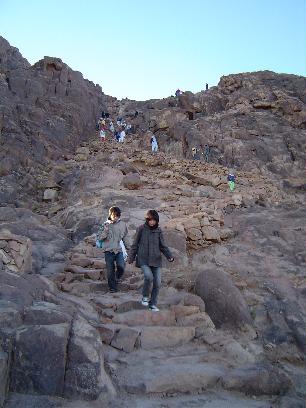 Our trip started at the hotel at 23:30, I had taken a short nap before I went to diner, so we went shortly after diner, already in complete darkness, on the road with the small bus that would bring us to the base of the mountain. The temperature was a pleasant 27 degrees Celsius. When we arrived at the parking lot near the Saint-Catherine monastery, we started walking the 'camel route', which is the easiest way to get on top of the mountain. There exists also 'stairs', some 3000 of them, which is not only the shortest route but obviously the strenous route and at night a little bit dangerous route. After escaping from the camels - obviously someone taking the camel route wants a camel ...? - we arrived after an hour or two at a small tea house nearly on the top, we drank a tea and ate a sandwich, and were ready to go the last part - here you have to take the last part of the stairs route, which took another half hour. We were the first persons on the top this night, so we had a good spot to sit behind a rock, protected from the wind, and I started to get dressed for the night, which means get out the gloves, woolen hat and down jacket out of my bag... The temperature : near to zero degrees Celsius. It was a clear night, and it was so quiet up here - till the masses arrived... it was getting soon too crowdy to stand and more and more people were hiring blankets from the bedouins, some people were only dressed in T-shirts , shorts and slippers... Our trip started at the hotel at 23:30, I had taken a short nap before I went to diner, so we went shortly after diner, already in complete darkness, on the road with the small bus that would bring us to the base of the mountain. The temperature was a pleasant 27 degrees Celsius. When we arrived at the parking lot near the Saint-Catherine monastery, we started walking the 'camel route', which is the easiest way to get on top of the mountain. There exists also 'stairs', some 3000 of them, which is not only the shortest route but obviously the strenous route and at night a little bit dangerous route. After escaping from the camels - obviously someone taking the camel route wants a camel ...? - we arrived after an hour or two at a small tea house nearly on the top, we drank a tea and ate a sandwich, and were ready to go the last part - here you have to take the last part of the stairs route, which took another half hour. We were the first persons on the top this night, so we had a good spot to sit behind a rock, protected from the wind, and I started to get dressed for the night, which means get out the gloves, woolen hat and down jacket out of my bag... The temperature : near to zero degrees Celsius. It was a clear night, and it was so quiet up here - till the masses arrived... it was getting soon too crowdy to stand and more and more people were hiring blankets from the bedouins, some people were only dressed in T-shirts , shorts and slippers... |
Sunrise
 | The wait till sunset was still a couple of hours, but the spectacle during the last half hour when the sun slowly came from behind the mountains was spectacular. After the last stars were gone, the mountain silhouets were becoming visible, but only faintly - it took still quite some time till the sun was appearing, first as a tiny dot , then in all its grandeur and brightness. The mountains were coloured in red all over now and only at this moment one could see how fantastic this point was we were standing... Most people hurried down immediately, I stayed a while to enjoy the feeling, and to go to the worst bathroom of my life on top of Mt. Sinai (highly not recommended). |
Saint Catherine Monastery
 | The road down was easy and no problem at all for me with the hiking boots, the 'hikers with the slippers' had more problems. And it is getting hot very soon ! When we arrived at the parking lot again, we waited to be allowed inside the Saint-Catherine monastery, which is an orthodox monastery and has a nice collection of old icons - too bad the monks don't allow you to look carefully and the lighting is really bad inside. Also inside is the burning bushes that Mozes encountered. A great way to end the climb of a holy mountain. |
Waterfall in North Carolina
8:52 AM
 |
| Waterfall |
To fully explore such a vast area is impossible so focusing on a certain area and walking in it is a popular way for people to take in their surroundings. You can take advantage of various well established trails within the forests and parks.
If you are visiting the North Carolina area to experience the scenery then there is also accommodation which can fit right in with your plans. There are a number of campgrounds and hostels across the area which welcomes walkers and those wishing to explore the area. The accommodation may be on the basic side of things but you are there for the outdoors but it is still clean and well equipped for all of your needs.
You should not expect to spend time in expensive theme parks during a stay in this area. Instead your main expenses apart from accommodation and food shall probably turn out to be the hiring of a bicycle so you can go along the paths that cut through the area. There are several companies that can provide such a service for you at perfectly reasonable rates both daily and weekly.
Food in the area can involve a lot more traditional food rather than having a range of cuisine from around the world. From steak houses to more up market food you can certainly have some excellent cooking without feeling you have paid over the odds and after a hard day of walking or cycling in the parks and forests you shall really feel the need to refuel with a good meal.
So visiting the North Carolina waterfalls can be a holiday that helps bring you closer to nature. It is a holiday designed for relaxation and enjoying the peace and quiet in the great outdoors. All you need is some basic accommodation and good footwear and a sense of exploration to get the most out of your holiday.
Source : _http://www.mytravelingstory.com/north-carolina-waterfalls
Turkey Bucket List
8:46 AM
Holidays in Turkey are increasingly embraced by package holiday tours and budget airlines, are far from restricted to basic sun, sand and sea breaks. It is an ever increasingly popular destination for travelers, especially as the country has been in the new a lot lately, it’s easy to get to from Europe, and it is very cheap.
You can take the grown up approach to Turkey and do things your friends may not have considered. Cheap Turkey Holidays usually means the flight itself and possibly accommodation. Once you are there, take advantage of the many east-meets-west cultural opportunities. Here are some things you can do on your trip:
Don’t miss the Sultan Ahmet Mosque during your holidays to Turkey. A series of magnificent domes and a feel of space, coolness and holiness. This is one of the most famous mosques in the entire world and whose size will truly awe you. Don’t go during prayer time as access to parts of the mosque is limited.
A holiday to turkey mean you can go to the moon. Not the real moon, but the lunar landscape that is Cappadocia, full of white volcanic ash, odd rock formations and a real sense of otherness. Turkey has amazing cities but to see the real natural beauty that is Turkey, you need to take a trip to Cappadocia.
Take a Blue Cruise. This is a boat trip along the Turquoise Coast, a lovely breezy coastal trip that takes in all the major ports, including Bodrum. Cruise around the Caspian see or down the Mediterranean and relax in the azure blue waters that surround Turkey.
Do make a visit to Asia Minor, or as it is know today, Ehpesus, home to one of the seven wonders of the world, the magnificent Temple of Artemis. This was one of the central sites for Roman civilization in Turkey and contains a lot of historic ruins.
Adventurers on holidays to Turkey will not want to miss kayaking in the Coruh River, a white water haven and home to the most exotic of flora.
Finally, for history buffs there is the lost city of Troy. This is where the famous story the Illiad takes place as it chronicles the end of the city of Troy and the war with Greece. It was thought to be a myth for many years until it was discovered in the 1800s. You will discover alters, remains and 4000 year old history galore.
Shop ’til you drop. This is an essential with cheap Turkey Holidays. Put on your bargaining head for the Grand Bazaar in Istanbul. The vibrant colours, the negotiations, the jewellery, ceramics and carpets will entice you, but do make sure you contain yourself – think baggage allowance.
READ MORE - Turkey Bucket List
You can take the grown up approach to Turkey and do things your friends may not have considered. Cheap Turkey Holidays usually means the flight itself and possibly accommodation. Once you are there, take advantage of the many east-meets-west cultural opportunities. Here are some things you can do on your trip:
Don’t miss the Sultan Ahmet Mosque during your holidays to Turkey. A series of magnificent domes and a feel of space, coolness and holiness. This is one of the most famous mosques in the entire world and whose size will truly awe you. Don’t go during prayer time as access to parts of the mosque is limited.
A holiday to turkey mean you can go to the moon. Not the real moon, but the lunar landscape that is Cappadocia, full of white volcanic ash, odd rock formations and a real sense of otherness. Turkey has amazing cities but to see the real natural beauty that is Turkey, you need to take a trip to Cappadocia.
Take a Blue Cruise. This is a boat trip along the Turquoise Coast, a lovely breezy coastal trip that takes in all the major ports, including Bodrum. Cruise around the Caspian see or down the Mediterranean and relax in the azure blue waters that surround Turkey.
Do make a visit to Asia Minor, or as it is know today, Ehpesus, home to one of the seven wonders of the world, the magnificent Temple of Artemis. This was one of the central sites for Roman civilization in Turkey and contains a lot of historic ruins.
Adventurers on holidays to Turkey will not want to miss kayaking in the Coruh River, a white water haven and home to the most exotic of flora.
Finally, for history buffs there is the lost city of Troy. This is where the famous story the Illiad takes place as it chronicles the end of the city of Troy and the war with Greece. It was thought to be a myth for many years until it was discovered in the 1800s. You will discover alters, remains and 4000 year old history galore.
Shop ’til you drop. This is an essential with cheap Turkey Holidays. Put on your bargaining head for the Grand Bazaar in Istanbul. The vibrant colours, the negotiations, the jewellery, ceramics and carpets will entice you, but do make sure you contain yourself – think baggage allowance.
Subscribe to:
Posts (Atom)
